Mastering Fields of Mistria: A Comprehensive Guide to Animal Breeding
Verified Insights & Analysis
Master animal breeding genetics in Fields of Mistria. Discover Tier 1 to 6 inheritance formulas, Golden Grain treat odds, and how conception dates unlock rare seasonal variants
Solve the puzzle of genetics and coat inheritance to dominate your farm.
💡 💡 Key Highlights & Tactical Takeaways
Fields of Mistria Animal Breeding & Coat Genetics Solver
Simulate animal coat color gene inheritance, parent affection tier bonuses, special treats, and rare pastel mutation odds.
Executive Summary
Mastering the sophisticated animal breeding mechanics in Fields of Mistria can lead to unparalleled economic rewards and genetic dominance.
- → ⚡ Exploit the rigid tier system to advance genetics.
- → 🎯 Utilize Golden Grain to enhance mutation probability.
- → 🛡️ Ensure optimal affection levels for unlocking rare phenotypes.
The core of successful animal breeding lies in optimizing the spatial, economic, and relational mechanics that influence livestock behavior. Understanding these foundational principles is essential before delving into advanced genetic manipulations. A strong infrastructure must support multiple breeding pairs and allow for rapid generational turnover.
- 🐔Coop & Barn: Housing structures for different animal species.
- ❤️Affection Requirement: Minimum 2 hearts for breeding eligibility.
- 🏠Capacity Management: Upgrade facilities to increase breeding pairs.
Livestock operations are divided into Coops and Barns. Coops accommodate smaller animals like chickens and rabbits, while barns house larger species such as cows and alpacas. Managing this capacity is critical, as available space dictates breeding potential and genetic progression.
Initial investment for basic infrastructure
Affection is a key factor in breeding mechanics. Each animal requires at least two hearts of affection to be eligible for breeding, a process that involves daily petting and feeding. The affection system significantly impacts the speed of generational turnover and is crucial for advanced breeding strategies.
The genetic architecture in Fields of Mistria is a tiered inheritance system ranging from Tier 1 to Tier 6. This system dictates offspring rarity through a combination of parent coat weighting, affection thresholds, and precise calendar timing. Understanding these variables is vital to achieving high-tier genetic outcomes.
| Tier | Description | Rarity | Probability |
|---|---|---|---|
| Tier 1 | Standard Variants | Common | High |
| Tier 2 | Enhanced Traits | Uncommon | Moderate |
| Tier 3 | Rare Mutations | Rare | Low |
| Tier 4 | Silver Coats | Epic | Very Low |
| Tier 5 | Gold Coats | Legendary | Minimal |
| Tier 6 | Seasonal Coats | Mythic | Special |
Same-tier breeding guarantees progression to the next tier, a crucial tactic for efficiently climbing the genetic hierarchy. Cross-tier breeding introduces probabilistic elements, offering potential tier jumps but at the cost of increased unpredictability and resource management challenges.
✅ Pros
- • Guaranteed tier progression with same-tier breeding.
- • Potential for rapid genetic advancement with cross-tier breeding.
❌ Cons
- • Cross-tier breeding introduces high risk and instability.
- • Strict requirement for affection and resource management.
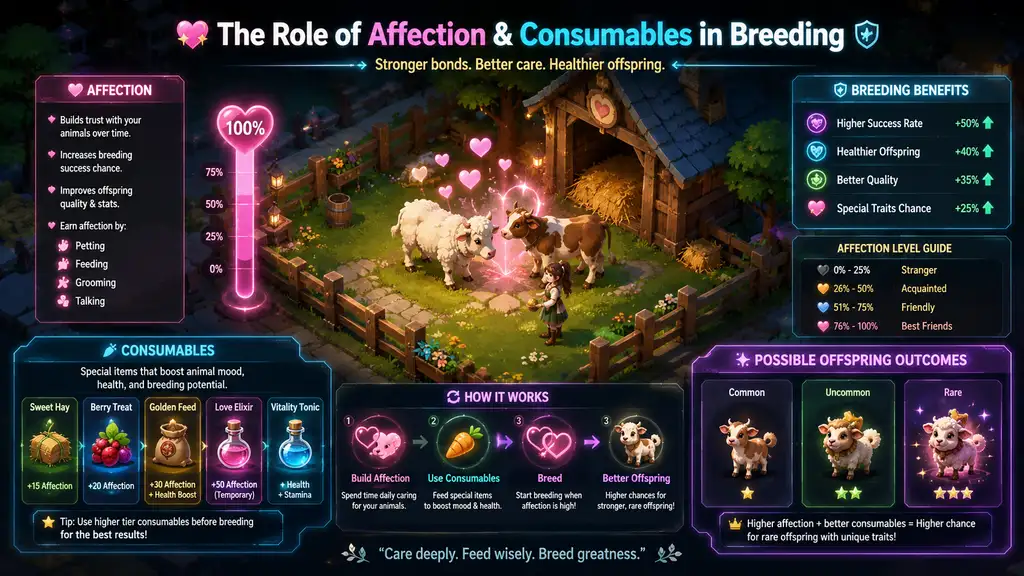
Affection plays a critical role in breeding success and genetic outcomes. Higher affection levels unlock rare coat colors and improve the probability of producing high-tier variants. Consumables like Heart Treats and Golden Grain are indispensable for manipulating genetic scripts and maximizing breeding efficiency.
🛡️ Key Takeaway
Maximize affection to unlock rare genetic traits and enhance breeding efficiency.
Heart Treats initiate the breeding sequence, requiring strategic planning for resource allocation. Golden Grain serves as a powerful additive, significantly boosting the probability of mutations and rare coat colors, essential for achieving high-tier genetic success within limited breeding cycles.
Coat color inheritance is influenced by parent traits, affection levels, and consumables. The genetic algorithm assigns a baseline probability for each color, which can be manipulated through strategic breeding practices. Understanding these probabilities is key to unlocking the full range of aesthetic possibilities.
| Configuration | Base Mutation | 5-Heart Bonus | Golden Grain |
|---|---|---|---|
| Tier 1 + Tier 1 | 5% Rare | 12% Rare | 28% Rare |
| Tier 3 + Tier 4 | 15% Rare | 25% Rare | 42% Rare/Tier Jump |
| Tier 5 + Tier 5 | Guaranteed T6 | 100% T6 | 100% T6 + Buff |
Affection bonuses and Golden Grain can significantly alter standard mutation rates, offering a strategic edge in achieving desired genetic outcomes. Breeding at higher affection levels increases the probability of pastel and metallic palettes, aligning with strategic goals for aesthetic and genetic diversity.
✅ Pros
- • Higher affection unlocks rare coat colors.
- • Golden Grain enhances strategic breeding outcomes.
❌ Cons
- • Requires significant investment in heart points.
- • Consumables add to resource management complexity.
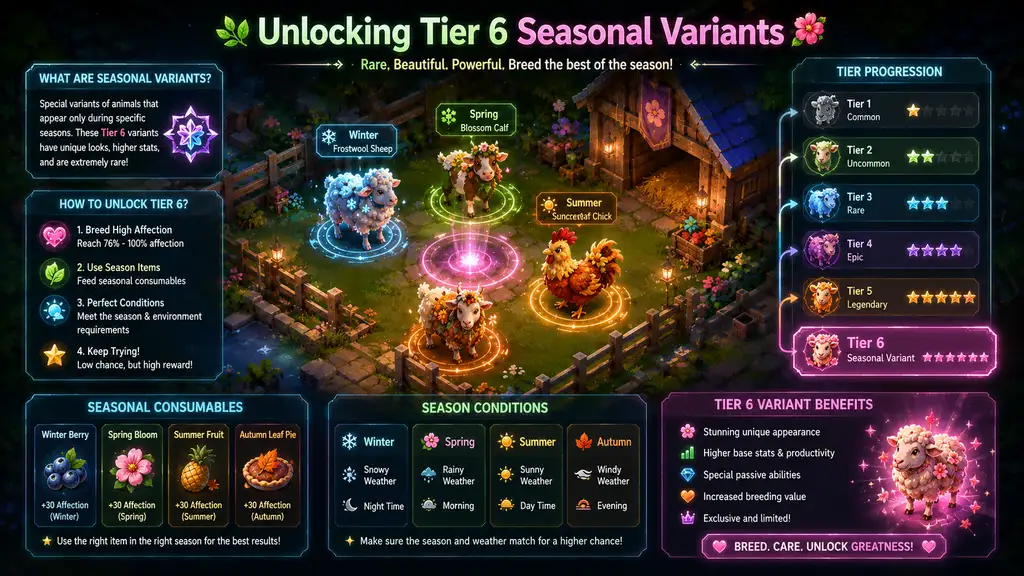
Tier 6 seasonal variants represent the pinnacle of Fields of Mistria animal genetics, tied closely to the game's calendar system. Achieving these rare variants requires precise planning and understanding of the conception date mechanics, which lock the animal's seasonal attributes at the moment of conception.
Ensures seasonal traits based on current season
The conception date, rather than the birthdate, determines the seasonal coat of a Tier 6 animal. This mechanism requires breeders to carefully plan the timing of Heart Treat administration, ensuring alignment with desired seasonal attributes for maximum genetic and economic advantage.
While breeding for aesthetics is a goal for many, maximizing economic returns through animal produce is crucial. Golden products, a key feature of high-tier animals, offer substantial financial benefits, transforming farm outputs into significant revenue streams through strategic breeding and resource management.
| Product | Standard Price | Golden Price | Cycle |
|---|---|---|---|
| Cow Milk | 40 Tesserae | 120 Tesserae | Daily |
| Bull Horn | 120 Tesserae | 360 Tesserae | Every 3 Days |
| Chicken Egg | 20 Tesserae | 60 Tesserae | Daily |
| Duck Feather | 90 Tesserae | 270 Tesserae | Every 3 Days |
| Horse Hair | 130 Tesserae | 390 Tesserae | Every 3 Days |
The economic advantage of golden products cannot be overstated. With significant price differences between standard and golden variants, strategically advancing animal heart levels to guarantee golden outputs is a primary focus for those seeking to maximize farm profitability and efficiency.
Navigating from a basic Tier 1 animal to a prestigious Tier 6 seasonal variant involves a strategic roadmap. This step-by-step guide ensures efficient progression through the genetic hierarchy while minimizing risks and maximizing breeding outcomes.
- 🚀Phase 1: Foundation - Start with T1 pairs for guaranteed advancement.
- 🧗♂️Phase 2: Climbing - Consistently breed same-tier pairs to reach T5.
- 🎲Phase 3: Golden Gamble - Use T5 pairs with Golden Grain for T6.
- 🔒Phase 4: Seasonal Lock-In - Secure T6 pairs for stable seasonal outputs.
The roadmap's design leverages guaranteed tier progressions and strategic consumable use to minimize randomness. This ensures a steady ascent through the genetic hierarchy, culminating in consistent production of Tier 6 seasonal variants for maximum economic yield and genetic diversification.
❓ Frequently Asked Questions
Q. Can animal tiers drop if I breed a high-tier animal with a low-tier animal?
No. The inheritance system prevents tier downgrades through a Zero Tier Regression lock, ensuring offspring maintain the highest tier level of the parents.
Q. What determines a Tier 6 animal's seasonal color?
The seasonal color is determined by the conception date when the Heart Treat is administered, locking the variant to the calendar season of conception.
Q. Does the "Golden Grain Treat" modifier apply retroactively to pregnant animals?
No. Golden Grain must be used before conception to affect probability outcomes, as bonuses are calculated during the overnight save when the seed is written.
Q. Are certain coat colors required to yield Golden produce?
No specific coat color is needed for Golden produce. Production is tied to heart levels, with higher levels increasing the guarantee of Golden products.
Q. How do I ensure a 100% Tier 6 offspring?
Breeding two Tier 6 animals guarantees a 100% Tier 6 offspring, aligning with the current seasonal attributes based on treat administration timing.
Q. What is the best way to maximize ROI in livestock management?
Focus on affection levels to ensure golden product output and invest in time-saving perks like 'The Bell Tolls' to streamline farm operations.
Q. Can I manipulate the RNG for breeding outcomes?
Yes, through 'save scumming': save before the overnight conception and reload if the outcome is not desired, allowing you to re-roll the RNG seed.
Q. What role do seasonal coats play in the economy?
Seasonal coats, especially Tier 6, offer aesthetic prestige and unlock high-value economic opportunities through exclusive drops and consistent high-tier production.
Q. Is there a fail-safe against poor breeding outcomes?
Yes, through strategic genetic planning and resource allocation, particularly in the use of consumables and affection management, which stabilize breeding success.
Final Verdict
In Fields of Mistria, mastering animal breeding requires a strategic blend of genetic understanding, resource management, and timing. By leveraging advanced mechanics and consumables, breeders can unlock rare animal variants and maximize farm profitability.
🔗 Interactive Calculator
Calculate exact numbers
Explore the Fields of Mistria Hub
Access our full suite of professional Fields of Mistria combat analytics, calculators, and in-depth guides.
Crop Profit & Regrowth Solver
Calculate daily profit, regrowth intervals, multi-harvest yields, fertilizer acceleration, and artisan processing value across 28-day seasons.
Livestock Breeding & Genetics
Simulate animal coat color gene inheritance, parent affection tier bonuses, special treats, and rare pastel mutation odds.
Artisan & Preserves ROI Pipeline
Compare raw crop selling vs Preserves Jars vs Keg Fermentation with Dragon Shrine Master Artisan perk multipliers.
Mines Combat & Biome Simulator
Floors 1-60+ drop rates, seal puzzle items, monster stats, armor deflection, and weapon DPS comparison.
Town Renown & Restoration Planner
Calculate daily renown velocity, request board turn-in schedules, shop tier unlocks, and story infrastructure projects.
Villager Schedule & Gift Database
Searchable villager gift preferences (+80 Loved, +45 Liked), heart event triggers, and daily seasonal schedules.
Museum Collection Tracker
Track seasonal insects, fish, artifacts, minerals, and flora with local storage persistence and location hints.
Seasonal Critter Catch Log
Filter fish and insects by season, weather condition, and time-of-day spawn windows.
Strategy Guides & Walkthroughs
Step-by-step min-max progression guides for Spring Year 1, Mines Mastery, and Museum Completion.