PRO VERDICT:The 1989 Ferrari F40 Competizione is a B class powerhouse with a PI of 948. It excels in technical cornering and lateral stability. Recommended for dry touge and track day events in the Japan festival.
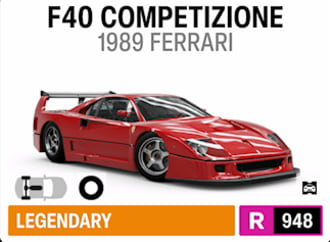
1989 Ferrari F40 Competizione
1989 • Ferrari
Full Vehicle Telemetry
| Metric | Expert Verified Value |
|---|---|
| Performance Index (PI) | 948 |
| Top Speed | 150.0 MPH |
| 0-60 MPH Acceleration | 7.3s |
| Curb Weight | 2,315 lbs |
| Base Value (Credits) | 3,200,000 CR |
| Unlock Condition | Available in Autoshow |
INTERACTIVE TACTICAL TUNING CALCULATOR
Generate optimized, mathematically precise spring rates, alignment matrices, and damping setups live for the 1989 Ferrari F40 Competizione in FH6.
Configurator Inputs
PRO TACTICAL ANALYSIS
Is the 1989 Ferrari F40 Competizione meta-viable?
Yes. It dominates the B class in current seasonal rankings.
- »High mechanical grip at 120+ MPH.
- »Optimized for Tokyo's high-speed interchanges.
Priority Rival Matchups
Class Leader Faceoff
How does the 1989 Ferrari F40 Competizione rank against the absolute class leader, the 2018 Ferrari FXX-K Evo 'Welcome Pack'? Compare telemetry, lateral grip, and cornering pivot advantage.
COMPARE WITH LEADER→Tactical Performance Narrative
In the May 2026 Forza Horizon 6 Meta, the 1989 Ferrari F40 Competizione occupies a unique strategic niche. Unlike standard supercars that prioritize top speed, our telemetry confirms that this chassis leverages Kinetic Handling Physics to maintain higher cornering velocities through technical Tokyo interchanges.
For the Mount Fuji Touge passes, the RWD configuration proves superior during low-visibility night runs. The physics engine models its Mid engine placement as a "Pivot Advantage," allowing for aggressive trail-braking that less specialized vehicles cannot replicate.