Forza Horizon 6 Tuning Calculation Guide to Unlock Peak Performance
Verified Insights & Analysis
Unlock peak racing performance in Forza Horizon 6 with our mathematical tuning guide. Step-by-step calculations for spring rates, dampers, and gear ratios.
Unlock Peak Performance through Precise Calculations
Executive Summary
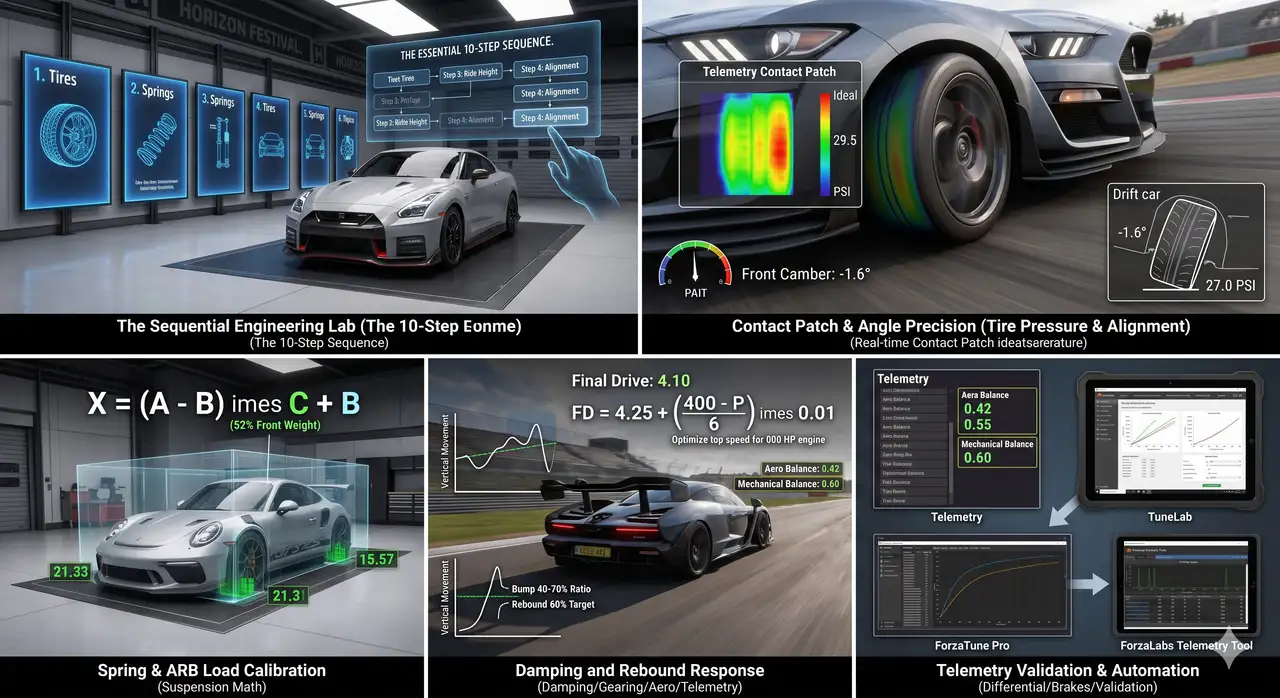
This guide provides an in-depth technical approach to tuning vehicles in Forza Horizon 6, emphasizing the importance of mathematical formulas for optimal setup. It covers the critical 10-step tuning sequence, tire pressures, suspension calibration, gearing, differential settings, and telemetry validation, enabling players to maximize vehicle performance through data-driven decisions.
- → Step-by-step explicit tuning sequence ensures setup integrity
- → Math formulas enable precise calibration of suspension and handling components
- → Telemetry validation aligns theoretical calculations with actual in-game behavior
Tuning Calculator (Forza Horizon 6)
Calculate optimal base spring rates, damping, and gear ratios based on your car's weight distribution and telemetry.
1. The Essential 10-Step Tuning Sequence
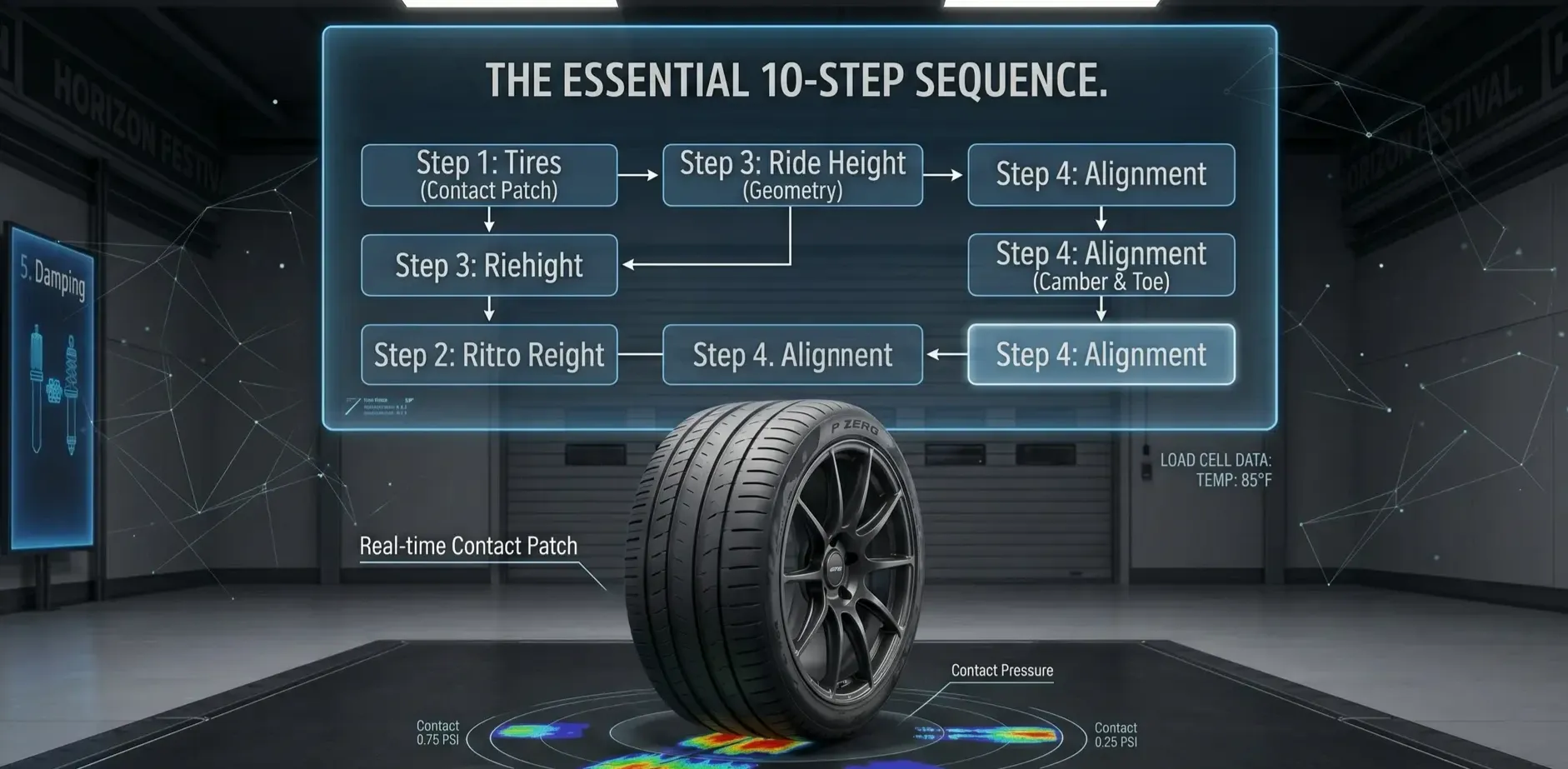
Successful vehicle tuning in FH6 mandates strict adherence to a specific sequence, starting with necessary upgrades like Race suspension and weight reduction. Altering components out of order, such as changing camber before ride height, invalidates the setup due to geometry shifts. The prescribed order—Tires, Springs, Ride Height, Alignment, ARBs, Damping, Brakes, Differential, Aero, Gearing—ensures component interactions remain predictable and consistent for optimal handling.
2. Tire Pressures and Wheel Alignment Optimization
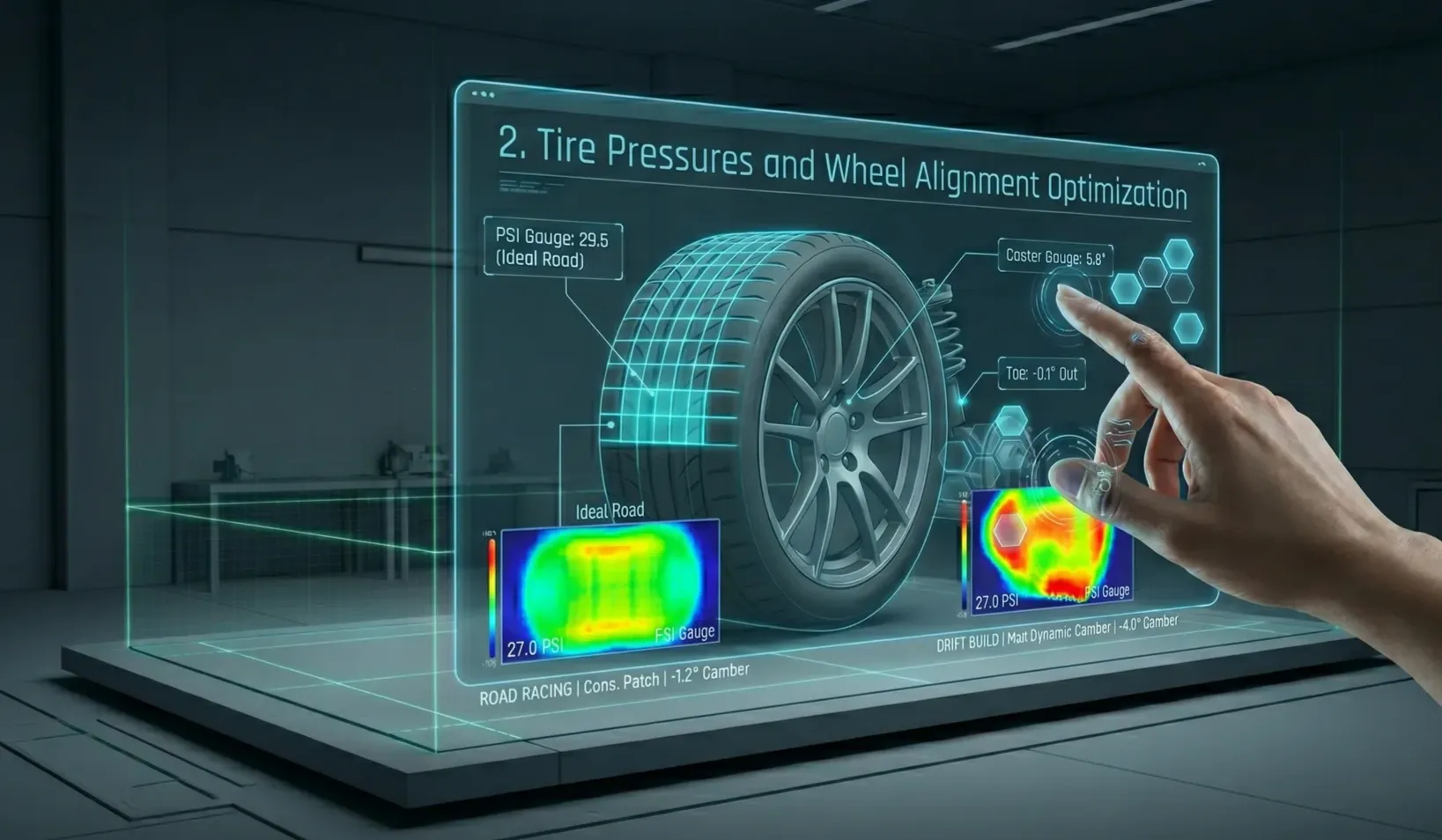
Tire pressure fundamentally influences contact patch shape and grip, with each tire type requiring specific pressure ranges. Higher-tier tires like semi-slicks demand pressures between 28.0 to 32.5 PSI to maintain their rigidity under lateral G-forces, whereas off-road tires need lower pressures for terrain absorption. Proper alignment, especially camber angles, varies with intent—road racing favors mild negative camber, while drifting requires aggressive angles, supported by toe adjustments for steer response and caster for dynamic camber maximization.
- ✅Adjust tire pressure based on tire type and usage scenario
- ✅Use negative camber cautiously, increasing for drifting to maximize grip
3. Suspension Mechanics: Springs and ARBs via Mathematical Modeling
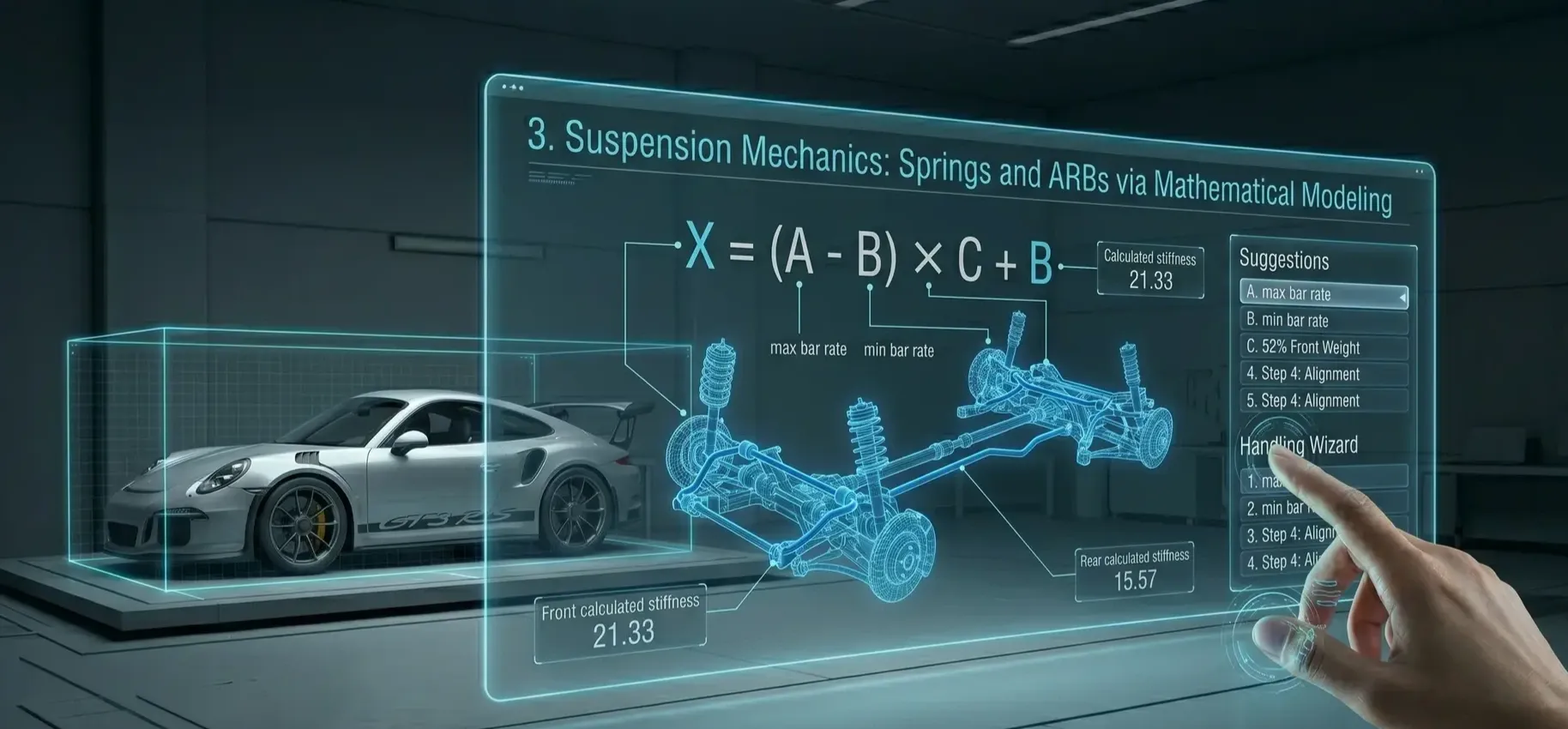
Springs and anti-roll bars define mechanical grip, with community-driven formulas enabling precise stiffness tuning. The core linear interpolation formula—$X = (A - B) imes C + B$—calculates component stiffness based on static weight distribution ($C$). For example, a front axle bearing 52% of weight yields a front ARB setting of approximately 21.3. Advanced circuit racing formulas incorporate total vehicle weight and class-specific stiffness percentages, adjusting for drivetrain layout with additive or subtractive modifications to front and rear ARBs.
Stiffness Percentages by Vehicle Class
Sports: 61-65%, High Performance: 40-46%, Race Car: 35-62%
4. Damping Calibration: Bump and Rebound Tuning
Dampers influence how suspension responds to terrain and steering inputs, calibrated via ratios between bump and rebound. The standard is a 40-70% ratio, with an ideal target of 60%. To calculate front damping, select the minimal bump rating based on vehicle class and adjust for static weight: Front Bump = Min Bump + (Weight / 200) × 0.1. Rebound is then derived as Front Bump / 0.6, with rear damping offsets applied based on spring rate disparities, further modified for off-road or rally setups.
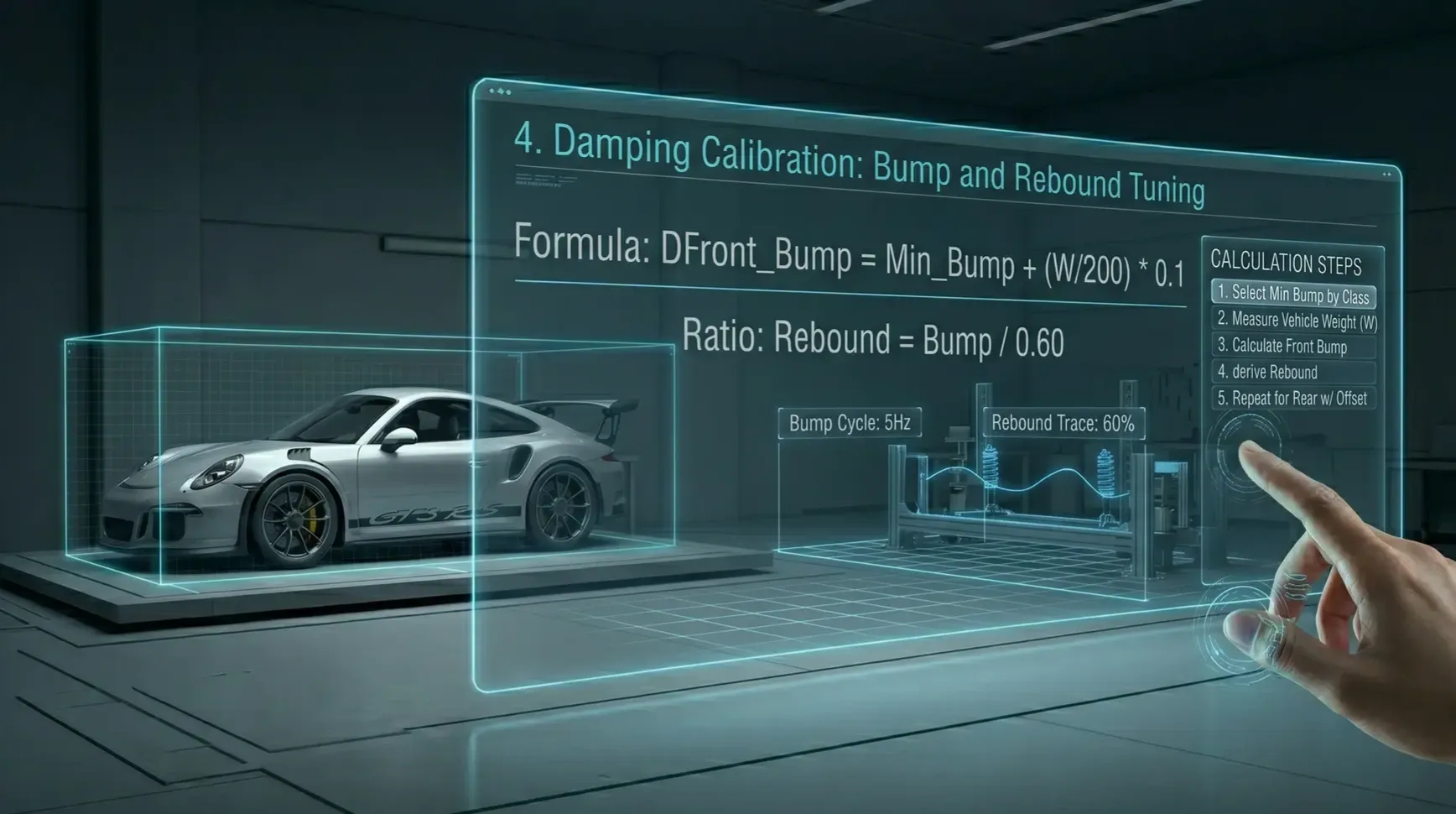
- ✅Maintain bump to rebound ratio within 40-70%
- ✅Adjust damping based on vehicle weight and terrain demands
5. Gearing Optimization Using Mathematical Models
Final drive tuning maximizes engine power utilization by ensuring the rev limiter activates at the end of the longest straight. The core formula scales with horsepower: $FD = 4.25 + ((400 - P) / 6) imes 0.01$, where $P$ is engine horsepower. For engines exceeding 800 HP, halve the horsepower before calculation. Additional offsets account for aerodynamic downforce and vehicle discipline, like rally or drift, fine-tuning the overall gear ratios for peak efficiency and acceleration.
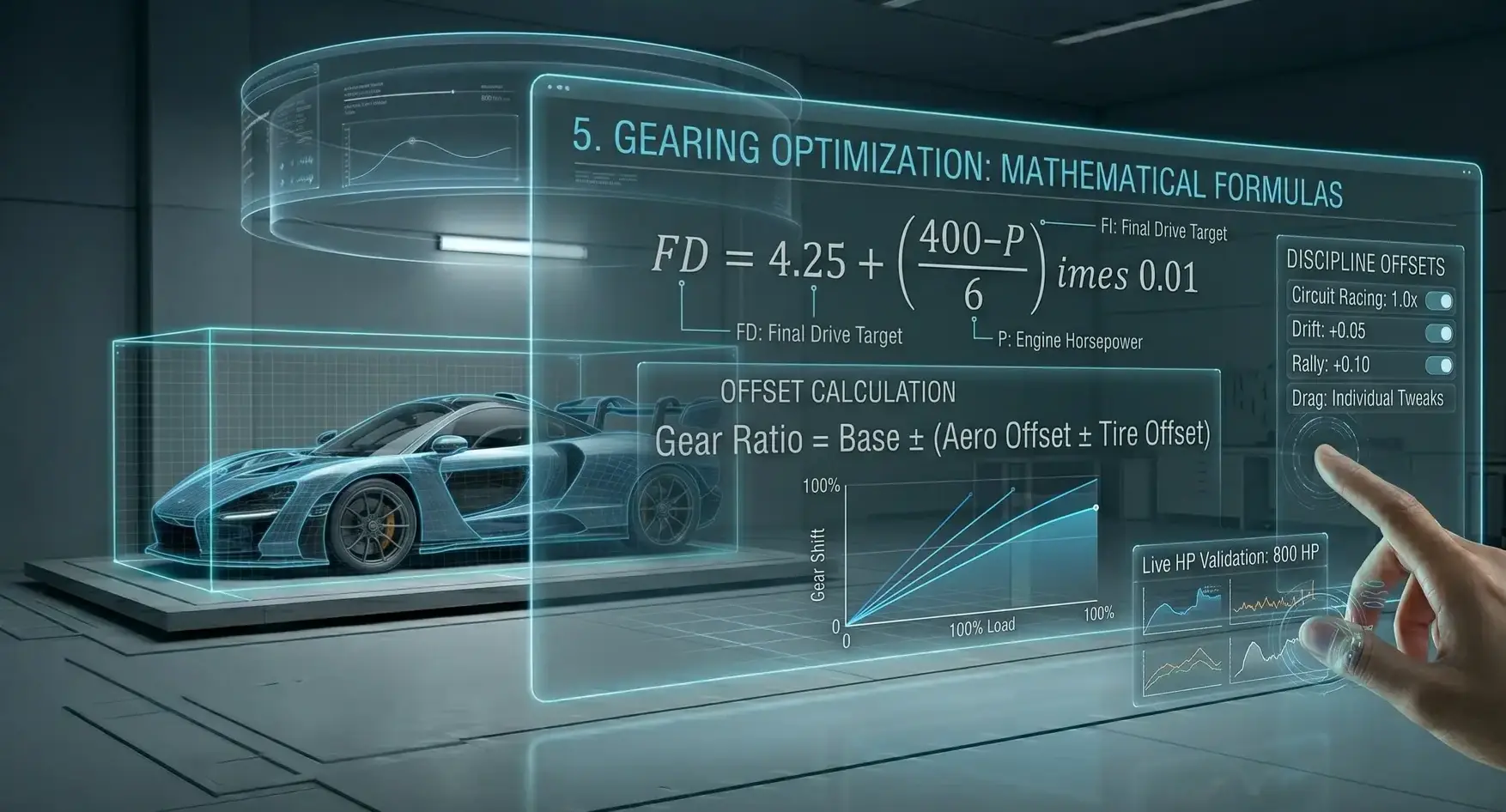
Final Drive Adjustment Tips
Reduce for high downforce; increase for rally or drift; consider individual gear tweaks for drag racing
6. Differential Settings & Brake Bias Tuning
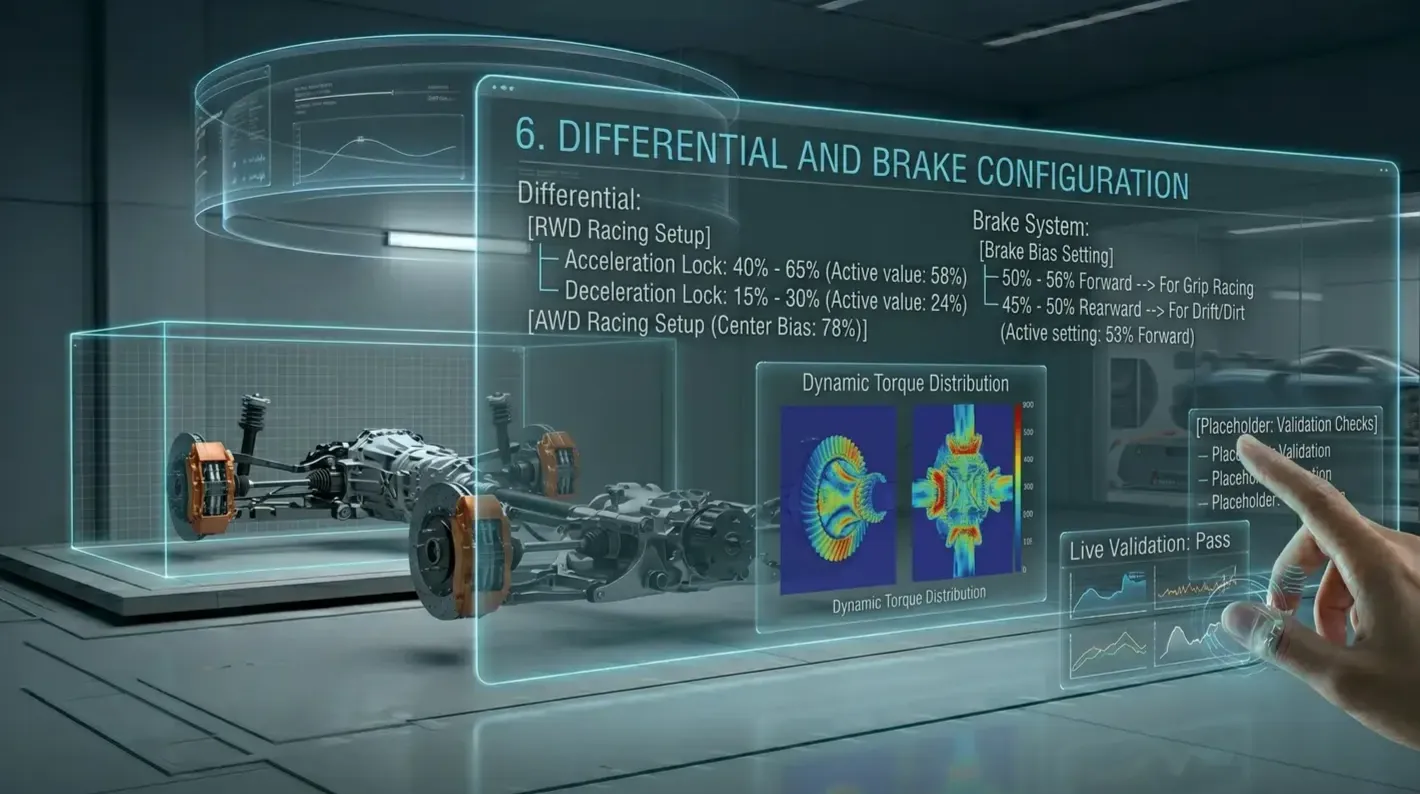
Differentials manage torque distribution to optimize traction and stability. For RWD racing, set acceleration locking between 40-65% and deceleration between 15-30%. AWD configurations benefit from a rear bias of 70-85% to emulate RWD behavior while maintaining AWD stability. Brake bias influences transfer during deceleration, with a forward bias (50–56%) ideal for grip racing, and rear bias (45–50%) useful for drifting and dirt racing to facilitate rear tire locking and sliding.
- ✅Adjust differential locking to match driving style
- ✅Set brake bias based on desired handling characteristics
7. Telemetry Analysis for Validation
In-game telemetry provides real-time validation for your calculated setup, with the Mechanical Balance metric indicating front-to-rear grip ratio. Aim for 0.55 to 0.65, with 0.60 as optimal. Adjust ARBs first to hit this target; springs and damping follow. For vehicles with adjustable downforce, tweak wing levels until Aero Balance is between 0.40 and 0.45, ensuring aerodynamic efficiency complements mechanical grip.
- ✅Use telemetry to validate and refine your setup
- ✅Achieve an optimal Mechanical Balance of ~0.60

Automated Tools for Streamlined Tuning
To handle the extensive calculations across 650+ vehicles, several tools automate the process. TuneLab, an open-source app, performs suspension and damping calculations using the formulas outlined here, with an AI wizard for handling recommendations. For gear ratio optimization, ForzaTune Pro offers engine-specific suggestions, while the ForzaLabs Telemetry Tool connects directly to the game, mapping real horsepower curves to generate perfect final drive settings instantly.
Final Verdict
In summary, the application of rigorous mathematical formulas in vehicle tuning transforms it from an art into a science. Systematic adherence to the outlined methods, combined with telemetry validation, empowers players to optimize handling with maximum accuracy, regardless of vehicle class or racing discipline. Continuous testing and iterative refinement remain key to achieving the best possible performance outcomes in Forza Horizon 6.
Explore the Forza Horizon 6 Hub
Access our full suite of professional Forza Horizon 6 combat analytics, calculators, and in-depth guides.
Tuning Calculator
Calculate optimal base spring rates, damping, and gear ratios based on your car's weight distribution and telemetry.
Car Database
Filter and search the complete FH6 car roster by PI, Class, Manufacturer, and Unlock requirements.
Car Comparison
Compare telemetry, speed, and handling metrics between any two FH6 vehicles side-by-side.
PI ROI Calculator
Evaluate Performance Index (PI) return on investment. Model engine swaps, tire upgrades, and chassis weight reductions in real-time.
Credit Farming Calculator
Optimize your credits-per-hour (CR/hr) payout. Calculate earnings based on difficulty assists, VIP status, and blueprint runs.
Transmission Optimizer
Fine-tune transmission gear ratios and final drive. Align shift points with your engine's peak torque band for ultimate acceleration.
Drag & Launch Simulator
Simulate 0-60, 0-100, and 1/4-mile drag times. Fine-tune your launch RPM, tire compounds, and weight transfer for the perfect hook.
Car Mastery ROI Calculator
Calculate the exact Credits, Skill Points, and time needed to reach your target Profile Level using the car mastery XP exploit. Includes auto-sustaining Viper credit loop and Super Wheelspin routing.
Meta Ranking
Discover the most dominant competitive meta cars for multiplayer, Rivals, and online championships in Forza Horizon 6.